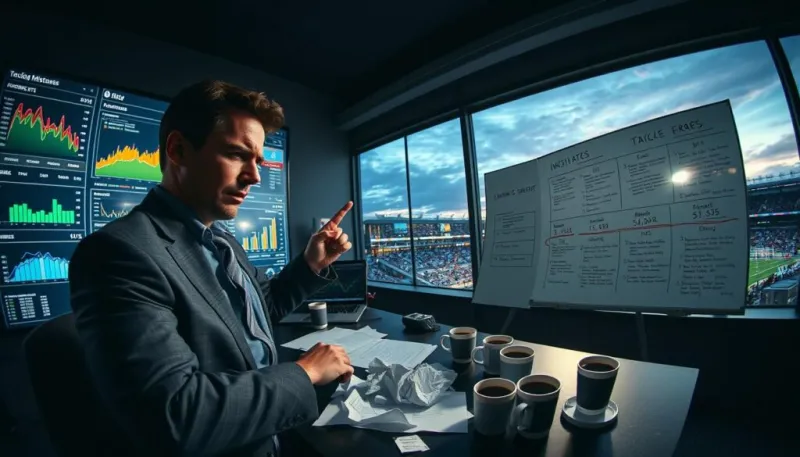
Live Betting Is a Rigged Race: How to Stop Being the Last One to Know

Photo: Nationaal Archief, CC0, via Wikimedia Commons
There's a moment every live bettor knows. You're watching the game, something shifts — a big sack, a turnover, a momentum swing — and you scramble to lock in what looks like easy money. You tap the bet. The odds have already moved. Or worse, the book suspends the market entirely for a few seconds, reopens it, and the number you wanted is just... gone.
That's not bad luck. That's the architecture of live betting working exactly as designed.
Sportsbooks have spent millions building the infrastructure to win the information war in real time. If you're betting live without understanding how that system operates, you're not gambling on the game — you're gambling against a machine that already knows what happened before you do.
The Broadcast Delay Nobody Talks About
Here's the uncomfortable truth: what you're watching on your TV or streaming app is not live. Cable broadcasts typically run three to five seconds behind real time. Streaming services — the ones most younger bettors use — can lag anywhere from five to twelve seconds depending on your connection, platform, and compression settings.
That might sound trivial. It is absolutely not trivial when you're trying to bet on a game in motion.
Sportsbook trading desks, meanwhile, are pulling data from official league feeds, stadium sensors, and in some cases their own on-site data scouts. That information hits their pricing models in under a second. By the time you see a quarterback get sacked on your screen and reach for your phone, the book has already repriced the next play, the drive outcome, and the halftime total.
You're not betting on what's happening. You're betting on what happened three to seven seconds ago. And the book knows the difference.
How Books Use Suspension Windows as a Weapon
Pay attention next time a big play unfolds during a game you're watching with the live betting screen open. The market will freeze — usually for anywhere from two to ten seconds — right at the moment the action peaks. Then it reopens with a new number.
This isn't a technical glitch. It's a deliberate risk management tool.
Sportsbooks suspend markets at high-volatility moments specifically to prevent bettors from acting on information the book hasn't fully processed yet. The irony? That suspension window is actually the clearest signal you'll get that something significant just happened. Books don't pause markets when nothing is going on.
Sharp live bettors have learned to treat suspensions as data. A market that freezes and reopens with a dramatically different line tells you exactly how the book recalibrated — and sometimes that recalibration overshoots, creating a brief window of value on the other side.
The Stat Stream Advantage
If broadcast delay is your enemy, real-time data is your weapon.
A growing number of serious live bettors have ditched the TV entirely — or at minimum, they're not relying on it to make decisions. Instead, they monitor official play-by-play stat streams, which update with significantly less delay than video feeds. Services like ESPN's live game tracker, the NFL's official Next Gen Stats feed, or dedicated sports data APIs can cut your information lag down to one or two seconds.
That's still not as fast as the book's internal feed, but it's a meaningful improvement. More importantly, it changes your relationship to the live market. You're reacting to text and numbers rather than emotionally responding to the visual drama of a broadcast — which, by the way, is exactly the environment sportsbooks want you betting in. Excitement drives impulsive wagering. Impulsive wagering is profitable for the house.
Cold, data-first live betting is a fundamentally different discipline.
Spot the Patterns Where Books Move Slow
Not every live market is equally efficient. Sportsbooks are very good at pricing the most-watched, most-bet games — NFL Sunday afternoon windows, prime-time NBA matchups, March Madness first weekend. The sheer volume of sharp action and algorithmic attention keeps those markets tight.
But move down the card? Early afternoon college football games, mid-week NHL, WNBA regular season, second-division soccer — these markets get less algorithmic love. Human traders are managing more games simultaneously, data feeds are sometimes less robust, and the pricing can lag behind game conditions by more than the typical few seconds.
Live totals in lower-profile games are a specific area worth studying. If a game's pace is dramatically different from what the pre-game total implied — say, a college basketball game that's running at a much faster or slower tempo than normal — the live total can be slow to fully adjust, especially in the first half.
The Momentum Trap
Here's a counterintuitive point that a lot of live bettors learn the hard way: the worst time to bet on momentum is when everyone can see it.
When a team goes on a 10-0 run in the second quarter and the crowd (and broadcast) goes electric, the live spread on that team has already moved to reflect the swing. You're not getting ahead of the market — you're buying in at the peak of the overreaction. Books know that casual bettors chase momentum, and they price the post-run number accordingly.
The sharper play is often the opposite: identifying when a market has overreacted to a short scoring burst and fading the momentum bet. Regression is real. Leads evaporate. A team that just scored three straight points didn't suddenly become a different team.
Practical Live Betting Habits Worth Building
None of this means live betting is impossible to beat. It means you need to approach it differently than most bettors do.
Reduce your broadcast dependency. Use a stat stream as your primary feed during live wagering sessions. Let the video play in the background if you want, but make your decisions off numbers, not what the announcers are saying.
Shop lines across multiple books in real time. Live line differences between sportsbooks can be significant — sometimes a full point or more on spreads. Having accounts at three or four books and checking them simultaneously before placing a live wager is basic table stakes for serious play.
Be selective. Live betting is designed to generate action on every possession, every drive, every at-bat. The book wants you placing ten bets a game. Sharp live bettors might place one or two — only when a specific, identifiable edge presents itself.
Understand your own delay. Know what platform you're watching on and roughly how much lag you're dealing with. This isn't something you can eliminate, but being aware of it stops you from acting on information that's already priced in.
The live betting interface is one of the most carefully engineered environments in modern sports wagering. It's fast, it's exciting, and it's built to move money from your account to the book's. That doesn't mean you can't find edges inside it — but finding them requires slowing down, thinking structurally, and refusing to play the game the way the sportsbook wants you to play it.